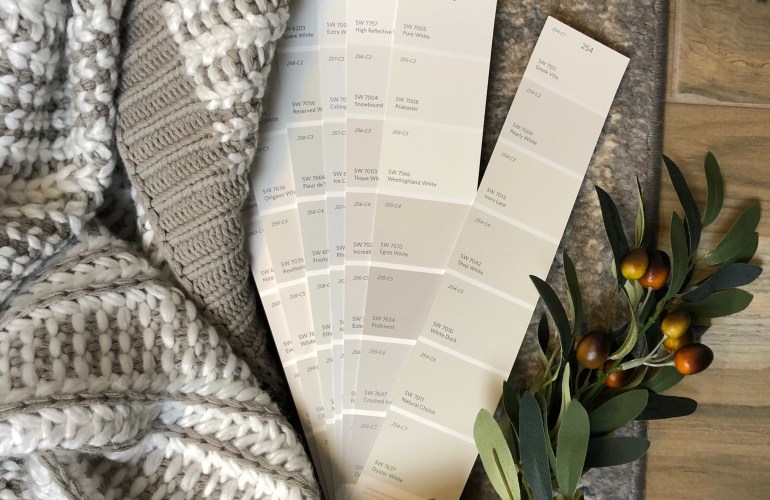
Paint, you’ve got a lot of options. There’s infinite colors (literally, did you know you can create custom colors at most major paint companies?). Then mix in all the different colors every paint company sells. Sherwin Williams and Behr and Benjamin Moore and the list goes on and on and on. They all sell their own named colors (hint: you can get most colors color matched by any of their competitors).
The current trend is open concept houses–even if your house isn’t open concept, using a cohesive color scheme will make it feel more open because your rooms will flow more naturally into them. I generally like my entire house (including bedrooms and bathrooms) to feed into a color scheme because I can easily shift decor around rooms. I touched on this in last week’s post about color theory (linked here), but I like to work in analogous and monochromatic whole-house color schemes because it makes it easy to have color consistency. Some people like to make their main living areas all cohesive and express themselves differently in bedrooms. Pick what works for you!
A Special Note
First and foremost, I always feel you should not let paint colors dictate materials you’re buying. If you’re replacing your floors, pick your floors first. Floors are far more permanent than paint colors. Same goes for tile, cabinets, backsplash, and on and on. That being said, if you are keeping your existing materials you need to factor those in to the color making decision. If you have travertine tiles, you need to find a color that works with travertine. I have bone/almond color bathroom fixtures in my hall bathroom, I needed to find colors that worked not just use my favorite white that would’ve made the fixtures look dingy (and yes, there’s 1,000 shades of white so my walls are still a creamy white but not a bright white). If you’re rolling your eyes at me differentiating creamy white from bright white, you haven’t stood in a paint aisle weighing out all the shades 😉
Why Create a Color Palette?
- Easily intermix and change existing decor throughout your house (I’m a big fan of shopping your home, save money but feel like you’ve got a new space)
- One palette means you can shop confidently knowing what goes and what does not — it also makes online shopping easier because you don’t have to be uncertain about if it’s the “right” shade to go with your 4,000 shades of green
- Lastly… a cohesive color scheme will make your home feel cozy while still open concept (even if you’re just faking open concept! Yay open without knocking out walls).
Crafting a Color Palette
Ok so you want a color scheme, but where do you start? I have a few easy places to start to help you decide which color palette is a good fit for you.
Finding your Color Scheme
- Scroll through Pinterest, look at your pins, look at the photos you’ve shared with friends as #goals… what are common colors you’re seeing throughout? Do you like bold colors everywhere? Light neutrals with pops of color? All neutrals everywhere?
- Check out your wardrobe. You laugh, but a lot of the colors in my home are the same colors I enjoy wearing. Is your closet full of patterns? Are you only wearing neutrals, blues and greens like me 😉 I’m not saying to turn your favorite shirt into a pillow to throw on the sofa, but just factor in which colors fit your vibe.
- Use color theory (seriously… if this concept means nothing to you, check out my blog post on it (linked here), it will change your interior decorating game. I live in an analogous cool tones color scheme (blues/greens/yellows) and monochromatic (single colors) with tons of neutral colors added in
- Recognize the colors already in your home. Do your wood floors have an orange tone? You’ll be in warm color shades. Are your cabinets blue? Plan for cool shades. Remember what I said above about planning based on what’s already in your home and staying, yes I meant it.
Find your White Paint Color
I start with finding a white (or a couple) as my base because there are so many shades of white. You’ve got warm whites, cool whites, bright whites, dingy whites, and there’s hundreds of them in that list. I like Sherwin William’s Alabaster because it’s a nice neutral color. It pulls slightly warm, which means in some homes with minimal natural light or warm white lightbulbs can cause it to read yellow. I also like Sherwin William’s Pure White as a truly white color, it doesn’t pull warm or cool, it’s the perfect shade of white to match any color palette. I’ve used Alabaster in my bedrooms and bathrooms and Pure White on all my trim, doors, detailed woodwork, kitchen cabinets, and hallways.
Find your Colors
Start Monochromatic
For example, when painting our house I knew I wanted a blue/gray color that would add “warmth” to my home. I chose Sherwin William’s Morning Fog as my base color. I used this color throughout my living room, dining room, family room and kitchen. All these rooms are connected with open doorways and the use of the one color connects them all. I wanted my laundry room and powder room to “go” with all the Morning Fog, but I wanted something lighter. I stuck within the color family and chose Reflection, which is a paler blue. I could’ve gone with Olympus White, which is two shades directly below Morning Fog, but I moved one shade over from Olympus White to get a color that brought in a slight bit more warmth. But my easiest recommendation when finding a monochromatic shade, is to choose one shade and work with the other shades that immediately surround it. See an example:

This is one paint panel, made up of Sherwin Williams Pure White through Crushed Ice. All these colors coordinate and play nicely together. You can repeat this process with any color. Say you want to find 5 shades of white that work well together. Or 5 shades of green. You catch my drift.
Get Analogous With It 😉
So I started with Morning Fog and mixed in a lil’ Reflection (along with my Pure White in the main areas). When working on my hallway mudlocker/hot-mess drop-zone, I wanted to bring in another color, because I wanted the cabinetry to be it’s own standout detail in my otherwise white hallway — I went with green. I found a shade of green that has hints of blue and remains a cool shade, since all my other colors are also cool tones. I landed on Sherwin Williams Oyster Bay, and I honestly committed to it by holding the color chips together to see if it looked pretty (which I think it does 😉 ) Sometimes the best thing to do is play with the online color picker or grab chips at the store, bring them home, and create combinations until you find one you like. This is what the Morning Fog panel, Pure White/Alabaster panel, and Oyster Bay panels all look like together:

All these colors play well together, because I’m not trying to introduce too many variations of green/blue/whites. All the colors in the green panel are rooted in the same shade of green, same for the blues, and the whites. It means they work together and don’t compete.
If you are going to add analogous colors into your monochromatic scheme, I recommend following my above suggestion of picking one color and using the shades that color surround that color. Otherwise you’re working in a LOT of tones to play with.
So You Want an Accent Wall?
I have 4 easy tips for picking an accent wall:
- Use the lightest shade from your monochromatic scheme
- Use the darkest shade from your monochromatic scheme
- For a light, neutral color room… use a dark, heavily saturated color (example: Sherwin Williams Crushed Ice paired with Sherwin Williams Tricorn Black as your accent)
- Pick a color that is complementary or split complementary to your base wall colors, aka opposite it on the color wheel (like red/green or green/purple/yellow). It’ll be visually pleasing and provide maximum contrast. This is the riskiest IMO because you’re introducing the most colors, but sometimes the riskiest gives you the biggest wow-factor.
Summary
Creating a whole house color scheme will create continuity through your home, allow you to make decor decisions confidently because you know what goes with which colors, and will give your house a more open concept feel. Rooms will flow more seamlessly together which will create harmony and balance. I recommend following a monochromatic/analogous color palette because you aren’t introducing too many colors. I also like mixing in a lot of neutral colors to help balance out colors.
At the end of the day you pick the scheme that works the best for you, that’s what makes your house feel like a home. Again, I would strongly suggest reading my color theory post (see here) for a background on how colors work together if it’s not something you’re familiar with. You won’t regret it 😉

 On Grove Road